

Archive for the ‘Patent Reform’ Category
US PTO to Hold Hearings on Effects of Patents on Genetic Testing
Two hearings have been scheduled by the US PTO on the effect of patents for Genetic Testing, to support the study that the PTO is mandated by the Leahy-Smith America Invents Act (“AIA”) to generate for Congress.
The first of the hearings is today. It will be broadcast via the Web.
The second of the hearings will be March 9 in San Diego. My colleague Prof. Chris Holman, incoming Executive Editor of Biotechnology Law Report, is scheduled to testify at that hearing.
Each of these agendas provides the logon information for the web broadcasts of the hearings.
U.S. Patent & Trademark Office Issues A Host of New Proposed Rules to Implement Amended Patent Law
With hundreds of pages of documents published during in the Federal Register during the last few days, the USPTO has issued a series of proposed rules and an upcoming fee schedule to take effect next year. See America Invents Act implementation micro website.
HAPPY NEW YEAR 2012
Congress Passes “Patent Reform”—The America Invents Act
As the editor of Elman’s Patent Reform News and chair of the Patent Legislation Committee of the Philadelphia Intellectual Property Law Association (PIPLA) for much of the past decade, I had a ringside seat this year as Congress gave a painful birth to the Leahy-Smith America Invents Act (“AIA”), which Pres. Obama signed into law on September 16th. A few of its provisions are now in effect, many will start up on September 16, 2012, and the rest will kick in on March 16, 2013.
In the past and currently, U.S. patent law has applied (subject to a serious burden of proof) the principle that the first person to invent something is entitled to a patent on it. But for future patent applications, from March 2013 on, this principle will be superseded by a different one: the first inventor to file a U.S. patent application will get the patent. That switch has gotten the big play in news reports, but in my view, that’s not where the most significant changes are. In fact, the AIA will put more responsibility on the patent office to expedite the patent examination process and then weed out improvidently granted patents by newly crafted administrative proceedings, soft-pedaling the role traditionally played by the federal court system. And more sources of information will be added to the prior art against which a patentable invention must be found to be both novel and non-obvious.
Also continuing in debate has been the question of what kinds of inventions should be coverable by patents. In June 2010 the Supreme Court addressed an aspect of this in the Bilski case. Now the issue is on deck with respect to a medical diagnostic test. Watch for the Supreme Court’s decision next year in Prometheus Labs v. Mayo Clinic. For more info, visit our website and send us your questions on patent practice.
Science Fiction Meets Legal Vision™
A year ago, I sponsored a panel discussion at the World Technology Summit of how science fiction authors such as Jules Verne, H.G. Wells and Robert Heinlein had uncannily envisioned the future. This year I took the opportunity to celebrate Damon Knight, who in 1953 conceived the technology of gene splicing, back when Watson and Crick had just sussed out the double helix structure of DNA. My story this year first took form in a display on the back cover of the June 2011 issue of Biotechnology Law Report, featuring an illustration by Philadelphia artist Tim Durning that transports yours truly into the world of Damon Knight’s novella Natural State, where a “house plant” is … the plant from which you’d grow your house.
30 Years of Biotechnology Law
I followed up on this subject in the article Highlighting the Course of Biotech Law published October 1 in the 30th Anniversary Issue of GEN Genetic Engineering and Biotechnology News. (The version on the Web links to a video podcast of my own prognostications.) That article reminds us that January 2012 also marks the corresponding anniversary of the first issue of Biotechnology Law Report, which I founded in 1982 with publisher Mary Ann Liebert and continue to serve as Editor-in-Chief. At this time I welcome the colleagueship of Steve Zweig who joins stalwart Judith Gunn Bronson on our BLR team, while bidding a fond farewell to Prof. Bob Bohrer.
Legal Aspects of Cybersecurity
Readers of last year’s edition of this newsletter will recall that I’d had the opportunity to meet Richard Clarke at a bar association luncheon in Washington, D.C. when he spoke about his book Cyber War. This fall I met Mark Bowden at the World Affairs Council in Philadelphia, promoting his book Worm: The First Digital World War. I cherish my autographed copy of each.
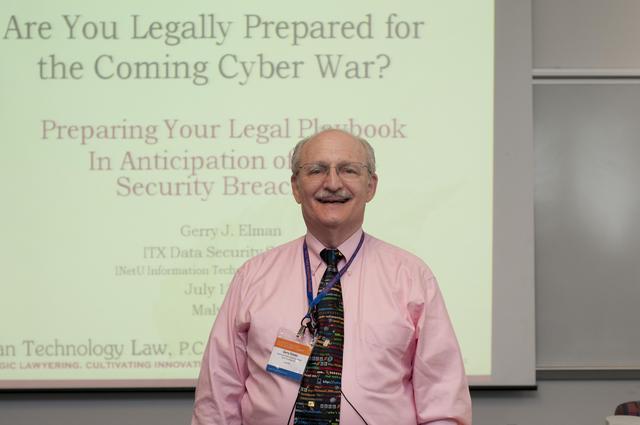
The February 2011 issue of Acquisition International magazine has an article for which I was interviewed about legal aspects of cyberspace. And in July, I gave a talk at the IT Expert Series Data Security Summit asking provocatively: Are You Legally Prepared for the Coming Cyberwar? Preparing Your Legal Playbook in Anticipation of Data Security Breaches. Don’t hesitate to contact me with any questions on the subject.Join Us on Social Networks
I invite you to visit our website for more information about our intellectual property and Internet business law practice. Also, I invite Facebook members to become fans of our Facebook Page by visiting it and clicking the Like button. Twitter users can follow @TechLaw_Elman and @ElmanTechNews for my latest updates in each field.
Family Matters
In June, my grandson in Hawaii, Elijah Suraj Elman Singh, was joined by a younger brother Joshua Devan and a cousin in southern California, Jack Michael. In October I had the pleasure of visiting grandson Jack and his adoptive parents. We also welcome into our firm’s extended family Scott Powell’s daughter Sylvie.
Once again …. a blessing: May happiness, health and prosperity be yours — next year and forever!
-Gerry
Watson, Come Here … You’re Needed at the PTO
WITHOUT A TRANSFORMATION OF THE INFORMATION TECHNOLOGY SUPPORTING PATENT EXAMINERS, “PATENT REFORM” WOULD BE LIKE REARRANGING THE DECK CHAIRS ON THE TITANIC
As I write on Saturday night, February 26th, the U.S. Senate is poised to vote Monday on a “Patent Reform” bill, S.23. The words “Patent Reform” have been on the lips of lobbyists and legislators since 2003. That’s when the Federal Trade Commission issued a white paper proposing a series of changes in the U.S. legal regime that provides the incentives for technological innovation that are mandated by the Constitution.
Many of the FTC’s proposals, intended to rebalance the tension between competition and exclusivity, have since then been addressed by the courts and are now off the table. Additional proposed changes to our patent system have come at the call of businesses that perceive themselves targets of a dysfunctional process that occasionally awards “junk patents” of dubious validity and yet fails to prevent their owners from unfairly demanding ransom in court. The concerns of such businesses are legitimate.
Another problem with the patent system arises from the principle that justice delayed is justice denied. A Milwaukee Journal-Sentinel article published January 29th by investigative reporter John Schmid is headlined: Patent backlog hinders nation’s job creation. Schmid, who has authored incisive “watchdog reports” on the subject since August 2009, sadly notes that the nation’s economic recovery “is excruciatingly behind schedule” and reports a new theory that has begun to circulate in Washington:
“Many of the missing jobs—hundreds of thousands or possibly millions—are buried under a backlog of 1.2 million unprocessed patent applications that have accumulated over the past 10 years at the U.S. Patent and Trademark Office.”
Quoting the CEO of a Silicon Valley startup, Schmid writes: “No patent means no funding and no business. … Hundreds of thousands of jobs ‘go un-created each year, all for lack of a patent.’”
On January 21st, PTO Director David Kappos said publicly that the backlog could ultimately cost the U.S. economy “billions of dollars annually in foregone innovation.” His comment is supported by a white paper issued by the Department of Commerce last April, which candidly admits that:
“[T]he current U.S. system is highly prone to delay and uncertainty as well as inconsistent quality. … Delay, uncertainty, and poor quality at the front end ultimately make private investments in innovation less likely and undermine the potential for economic growth and job creation.”
The April 2010 white paper points out the particular importance of “patent quality” to biotechnology:
“[H]igh quality is a feature of patents held by successful, growing companies in industries like the pharmaceutical industry. Moreover, economists have argued that this high quality contributes significantly to making pharmaceutical patents valuable to the industry, even after the costs of defending against patent litigation are taken into account. Similarly, surveys of CEOs and R&D managers have shown that patents are among the most important means for securing competitive advantage from pharmaceutical innovations. The so called “patent premium” (i.e., the incremental value realized on an invention by patenting it) also tends to be highest for biotechnology, pharmaceutical, and medical device companies. For those companies, a 10% increase in the strength of patent protection available to meritorious patents is associated with a 9-10% increase in R&D expenditures, which in turn drives innovation and growth.’”
Unfortunately, to me S.23 seems mostly to rearrange the deck chairs, without plugging the hole in the hull. The only thing in S.23 that might improve the process of examining patent applications would be the provision that allows the PTO to freely raise the level of fees it charges to patent applicants, without having to beg Congress. Perhaps with such an authorization, along with a needed provision preventing Congress from later diverting such fees to other purposes, now would be the time for us to share a bolder vision of how to use some of that money to strike at the heart of the problem.
From February 14th to 16th, the tv show Jeopardy! featured a man-machine showdown that’s piqued the public fancy. An IBM computer named Watson beat out a couple of human champions at that show’s sophisticated quiz game. On the 15th, using the Jeopardy! battle as a news peg, Martin Ford published an article in The Atlantic suggesting that soon computers will be able to do the job of a lot of lawyers. Last weekend the author also spoke about it on National Public Radio.
Ford’s article reminds us that over the past several years, computers have been developed that respectively beat chess champions Kasparov and Kramnik, and then speculates that:
“If you agree that the game of chess requires creativity within a set of defined rules, then could not something similar be said about the field of law? Currently there are jobs in the United States for many thousands of lawyers … in the areas of legal research and contracts. They … spend much of their time in the library or accessing legal databases through their computers. …
“What about automation? Can a computer do the lawyer’s job? One of the primary research areas in artificial intelligence has focused on creating ‘smart’ algorithms that can quickly search, evaluate and summarize information. We see the fruition of this body of research every time we use Google or any other advanced Internet search engine. We can expect that such smart algorithms will increasingly be used in the field of legal research. The software may start out as a productivity tool to make the lawyer’s job easier, and then eventually evolve into a full automation solution.”
Coincidentally, on February 16th, Alexander Poltorak (CEO of General Patent Corporation and founder of American Innovators for Patent Reform) received a formal notice from the PTO that his U.S. Patent 7,904,453 for APPARATUS AND METHOD FOR ANALYZING PATENT CLAIM VALIDITY is scheduled to issue on March 8th. Does Poltorak’s patent disclosure lay the foundation for a computer that would eliminate the jobs of patent examiners? Well, maybe it won’t go all the way, but it should point us towards more efficient use of their expertise, so as to reduce the backlog and help to realize the goal of better “patent quality.”
As I said, critics assert that all too often the PTO issues “junk patents.” Everyone agrees that those patents which claim subject matter that is already in the prior art have been “anticipated” under section 102 of the U.S. patent law and should not have been issued. When Jon Dudas was Director of the PTO from 2004 to 2009, he touted a declining rate of allowance of patent applications as evidence that “patent quality” was increasing. However, I believe that, by and large, the patent examination practices of that era merely created a bottleneck which led to longer pendency but not much of an improvement in the ratio of valid patents to invalid ones. To increase “patent quality,” I believe that the process of examining patent claims needs to be reengineered.
A proposed patent claim has to get past several legal hurdles before it is deemed legally allowable. Section 103 of the U.S. patent law requires that the subject matter of the claim not have been “obvious” to a person having ordinary skill in the art. Until this fuzzy test is made crisper, either by statute or court interpretation, I think the judgment call of “obvious-or-nonobvious” will still need to be made by a person, not a machine.
Yet, isn’t it time that the society with the most powerful information technology in human history provide to those persons, examiners at the PTO, a tool that presents an organized report of the prior art that’s most pertinent to each element of each claim under examination? In effect, it would be an automated version of the Examination Support Document (“ESD”) that in 2007, the Dudas-led PTO had announced it would require many patent applicants to generate.
In the face of widespread criticism, the PTO thankfully withdrew that proposal. But the criticism focused on the extreme burden on patent applicants being required to manually prepare such analyses, as well as the legal risk of creating an Achilles heel by making an inadvertent error or omission. (“To err is human.”) Nobody said that if a patent examiner were to be presented with such an analysis, it wouldn’t help him do his job. These days, a remnant of the proposal remains in the option to seek accelerated examination by submitting a similar report. See MPEP 708.02(a) and related guidance.
Back in 2007, I was impressed by a publicity piece issued by the intrepid folks operating the PatentCafe.com website. They had just announced a commercial service to automate the creation of an ESD.
At that time, I published in Biotechnology Law Report an editorial urging that the PTO provide such technology as an in-house tool for use by patent examiners. Doing so, rather than requiring an ESD from outside, would relieve the applicants and their attorneys of the burden and risk, and yet lead to patents of improved “quality.” I commented that
”This would be analogous to the deployment of the automatic telephone exchange, after anticipated growth of the switchboard phone system couldn’t be supported without recruiting every woman in America to work as a telephone operator.”
Sadly, I am not aware that the PatentCafe ESD product as originally announced ever reached fruition. The impetus for it dried up when the PTO dropped the proposal to require certain patent applications to include an Examination Support Document. However, the project by PatentCafe seems to have morphed into what is now Pantros IP. In addition, the patent-searching tools offered by Lexis-Nexis now include an option to employ semantic analysis. So the requisite technology seems to be evolving as needed.
Now that IBM has demonstrated the ability of their Watson system to draw sophisticated conclusions from a vast repository of text, I submit that the time has come to enlist such technology in the service of the PTO towards more speedily generating a higher quality patent examination. With one stone, this should help kill the two birds of “junk patents” and the “backlog of unexamined patents” described above.
With “Patent Reform” at the top of the Senate’s agenda for the end of this month, it is imperative that the legislature support implementation of computer-assisted patent examination. Sadly, the Senate has failed to include this task in the bill scheduled for vote on February 28th. We urge Senators to amend Bill S.23 to include such means to help examiners to improve the quality and efficiency of the patent-examination process.
And there is good news from the House of Representatives. As reported Feb. 13th by The Hill, Rep. Bob Goodlatte (R-Va) is slated to spearhead the House version of Patent Reform. He said in an interview taped to air on CSPAN’s “The Communicators,” that the most likely focus of the legislation would be on “increasing the speed and quality of the patent process,” commenting further that the PTO “doesn’t use enough technology to ensure products are unique and worthy of a new patent, making the process slow and cumbersome.”
It seems to us that Rep. Goodlatte is spot-on. We urge both houses of Congress to focus their “Patent Reform” initiatives to follow through on this. It is imperative that Congress encourage PTO Director Kappos to invest in 21st Century systems to transform the patent-examination process. Having come to government service from a career at IBM, he is uniquely qualified to lead us towards this beneficial transformation. See Edward Wyatt’s article in the Herald-Tribune of Feb. 21: U.S. Sets 21st-Century Goal: Building a Better Patent Office.
Until the PTO provides a Watson-like analytical infrastructure for patent examiners, it seems to me that the whole patenting process will remain in jeopardy. In the legendary words of Alexander Graham Bell: “Watson, come here. I want you.”
HAPPY NEW YEAR 2011
World Technology Network
During the past year, Elman Technology Law, P.C. (“ETL”) sponsored two programs of the World Technology Network. Earlier this month, we participated in a World Technology Summit, an annual event that I first attended in London in 2001 as a founding member of the WTN. Each Summit is a two-day conference with a variety of presentations and active workshops, culminating in a gala World Technology Awards dinner honoring individuals and companies in various categories, including technology law. At this year’s Summit, our firm sponsored a roundtable of Science Fiction authors, including my friend and mentor Paul Levinson. Click here for more about this illuminating program on How Sci-Fi Legends Dream the Future for Us.
In June, we sponsored the WTN’s East Coast premier of a film by another dreamer of the future. Ray Kurzweil invented, among other things, the omni-font scanner and text-to-speech readers. Based on his 2005 book The Singularity is Near, Kurzweil has now produced a feature-length film of that title. Before the film screening, he spoke of his calculations showing exponential growth of technologies, that lead him to expect a “singularity” within the next few decades. At that point, the computational power of the world’s computers would exceed that of humanity’s collective brains, and biological evolution would be superseded by development of information technology. Watch this space for information about a biographical film about Kurzweil entitled Transcendent Man, which we expect to see again this year.
Go West Young Man
This summer, our colleague Scott Powell moved from New York City back to the Midwest, accompanying his wife Christy to Bloomington, Indiana, as she pursues a Ph.D. in Education. Though Scott is now even farther away geographically, he retains his affiliation with our firm and is a productive member of the growing cadre of teleworkers. Already a patent attorney and a member of the Bar in Pennsylvania, Scott has added the Indiana Bar to his credentials. He continues to provide a high level of service for our clients for a variety of patent, trademark and Internet business law matters, working with us as closely as he did when he was here in Media, Pennsylvania.
And … Returning to Kansas City
Last year at this time, we introduced Jerome Smith as our newest colleague at ETL. Alas, next month Jerome will be leaving us to take on the in-house role of Senior Intellectual Property Counsel of Adknowledge, Inc., a long-time client of Jerome’s that became an ETL client upon Jerome’s arrival. He’s moving to Kansas City, Missouri, from whence he had come to the Philadelphia area. The good news is that our firm will continue to serve as outside IP counsel for Adknowledge, and will provide support for Jerome and the Adknowledge team of inventors and managers. Though we will miss having Jerome in the office, we expect our connection with him to remain strong.
Developments in IP Law
In 2010, the question of what kinds of inventions can be patented has been hotly litigated, from the Supreme Court’s decision in the Bilski case focusing on the unpatentability of abstract ideas, to the challenges to Myriad Genetics’ patents claiming isolated portions of genes. Scott Powell, who spent the first half of 2010 in New York City, had the catbird seat for events there while the Myriad Genetics case was unfolding, and he collaborated with me in chronicling the proceedings. Visit our blog to see the articles on this case that we published in GEN and Biotechnology Law Report. In Washington, D.C. and CyberspaceIn October, M.P. Moon and I attended the Annual Meeting in Washington, D.C. of the American Intellectual Property Law Association. We took part in workshops on such matters as dispute resolution, the patenting of biotechnology in uncertain times, chemical patent practice, and copyright law.
Also in Washington that month, my wife Lois and I attended an American Bar Association luncheon sponsored by the Standing Committee on Law and National Security. It featured a lecture on the subject of cyberterrorism by Richard Clarke, author of Cyber War. Since then, in the wake of recent WikiLeaks disclosures, examples of cyber attacks have raised awareness of such threats. Stay tuned for further developments on this front.
In cyberspace, trademarks and domain names are increasingly valuable, substituting for the façade of a building. Scott Powell and I recently published an article on an aspect of this subject in the August-September issue of World Trademark Review. Don’t hesitate to ask us for more information on the various legal issues, local and international, that arise on the Internet.Join Us on Social Networks
I invite Facebook members to become fans of our Facebook Page by visiting it and clicking the Like button. Twitter users can follow @TechLaw_Elman and @ElmanTechNews for my latest updates in each field.
Family MattersLast year at this time I wrote of the passing of my mother. This year, my family and I fulfilled my parents’ wishes to scatter their remains into the sea. In October, we participated in a lovely ritual in San Pedro Bay, conducted on a boat of the Neptune Society. Lois and I got the chance to see my brother and sister, our nephews, who filled us in on doings with their babies and their careers in Silicon Valley, and to spend time with my daughter Floren, her husband Sodhi, and my 32-month-old grandson Elijah.
Once again …. a blessing: May happiness health and prosperity be yours — next year and forever
-Gerry


